

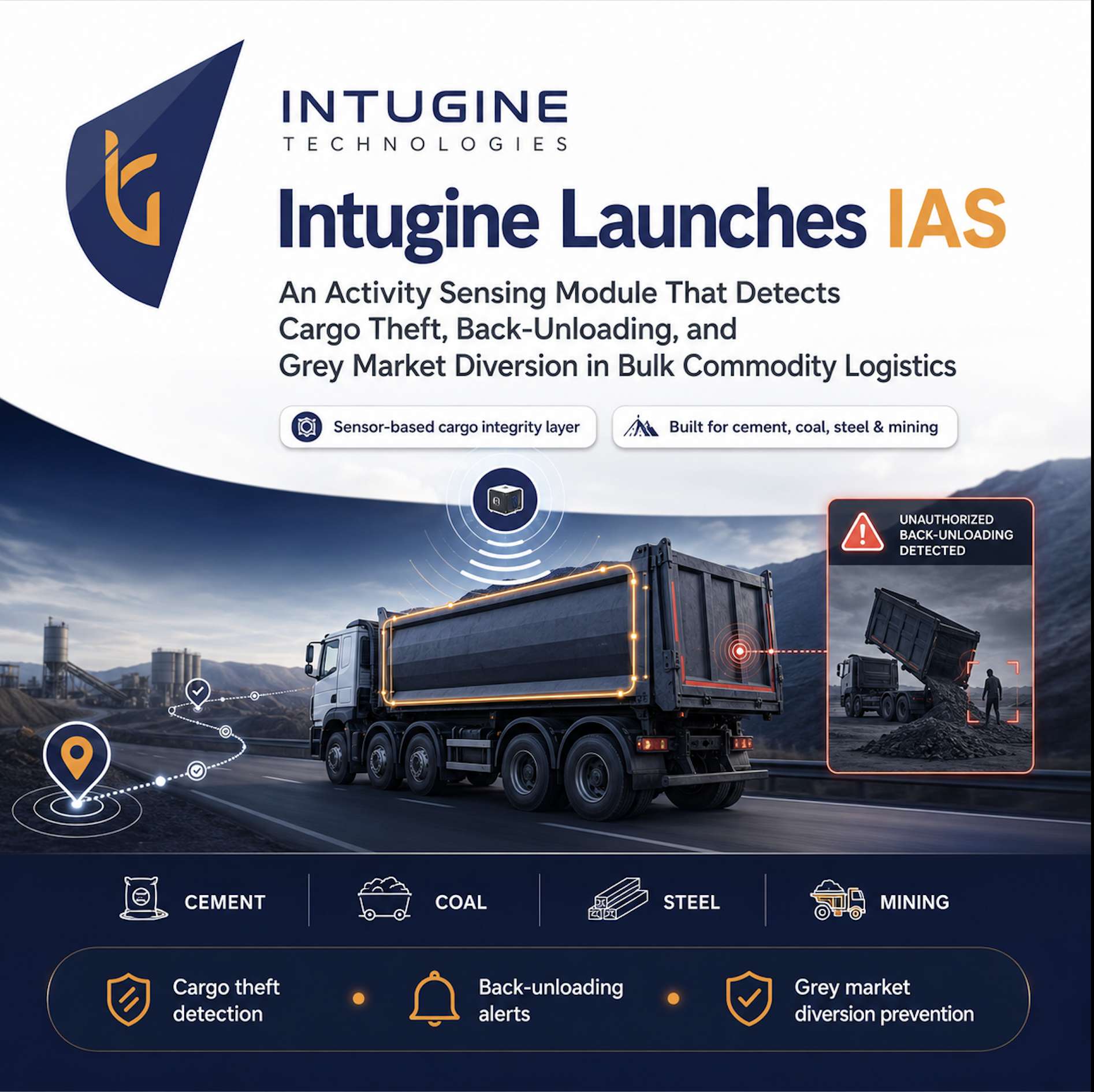
Bengaluru, India — June 2026 — Intugine Technologies, India’s supply chain intelligence platform tracking over 7 million trucks, today announced the general availability of its Intugine Activity Sensing (IAS) module — a sensor-based cargo integrity layer designed for bulk commodity logistics in industries where in-transit theft, back-unloading, and grey market diversion represent a material and recurring revenue loss.
IAS is purpose-built for operations that GPS has never been able to fully protect. A truck’s location tells you where it is. It does not tell you whether the cargo was offloaded at an unauthorised point, whether a partial unload happened before the delivery site, or whether the driver stopped at a dealer not on the dispatch order. For bulk commodity shippers — cement plants, coal-fed thermal power stations, steel and sponge iron manufacturers, mining operations — these are not edge cases. They are systematic leakages that erode margin at scale.
The Problem GPS Cannot Solve
In cement distribution, grey market diversion — where drivers divert loads to secondary dealer locations at higher spot prices — costs large manufacturers an estimated 2–4% of outbound volume annually. In coal logistics, in-transit pilferage and short delivery disputes between mines, transporters, and plants run into hundreds of crores across the industry each year. In steel and metal logistics, back-unloading of scrap and raw material is a persistent blind spot that geofencing and GPS trails cannot detect.
The common thread: location data proves where the truck went. It cannot prove what happened to the cargo.
How IAS Works
IAS uses activity sensing using sensors to detect physical events at the cargo level — unloading activity, loading events, door open/close signatures, and cargo movement patterns — independent of GPS location. The sensor captures what the vehicle’s body is doing, not just where it is. This creates an evidence layer that GPS cannot provide.
When IAS detects an anomaly — unloading activity at a location that is not the authorised delivery point — it triggers an immediate alert with sensor evidence, timestamp, 360 view street images processing and GPS coordinates. The alert is not based on a driver’s statement or a coordinator’s assumption. It is based on physical data from the cargo layer itself.
IAS covers three primary integrity scenarios:
- Back-unloading detection: Physical unloading activity detected before or away from the authorised delivery point — immediate alert to the shipper’s operations team and transporter desk
- Grey market diversion prevention: Unloading events at locations that do not match the dispatch order — evidence captured for dispute resolution and transporter accountability
- Short delivery and pilferage detection: Partial unloading events detected in transit — timestamps and sensor signatures logged as evidence for weight reconciliation and claim substantiation
Industry Applications
For cement manufacturers, IAS closes the grey market loop. Dealers who receive diverted loads are identified from sensor evidence, not driver confessions. Transporters with repeat diversion patterns are flagged automatically. The system integrates with dispatch and dealer management systems to cross-reference every unloading event against the authorised delivery record.
For coal and power sector logistics, IAS provides pilferage detection across mine-to-plant corridors — the stretches where manual oversight is weakest and cargo losses are highest. Unloading events in transit are captured and timestamped. Short delivery disputes are resolved with sensor evidence rather than contested weight slips.
For steel, metal, and mining operations, IAS detects back-unloading of inbound raw material — iron ore, scrap, coal — before it reaches the plant gate. Operations that previously relied on weight reconciliation at entry to identify losses now have an in-transit alert layer that catches the event as it happens.
“Bulk commodity logistics in India has a cargo integrity problem that the industry has accepted as a cost of doing business,” said Harshit Shrivastava, CEO at Intugine. “IAS changes that. When you can prove what happened to the cargo — with sensor data, not just GPS breadcrumbs — theft, diversion, and short delivery stop being a write-off and start being an actionable, recoverable loss.”
Key metrics from IAS deployments:
- Back-unloading events detected within minutes of occurrence
- 2–4% outbound volume recovery in cement grey market deployments
- Zero reliance on driver statements — all alerts based on physical sensor data
- Integrates with existing TMS, ERP, and dispatch management systems
- Deployment live within 1–2 weeks
IAS is available as a standalone module and as part of Intugine’s full supply chain intelligence platform. It is currently deployed across cement, coal, steel, and mining operations in India.
About Intugine Technologies Intugine is India’s supply chain intelligence platform, providing real-time visibility across road, rail, and air freight through a network tracking over 1 million trucks. The platform’s activity sensing technology and AI control tower capabilities serve enterprise shippers across cement, FMCG, pharma, steel, coal, and e-commerce sectors.
