

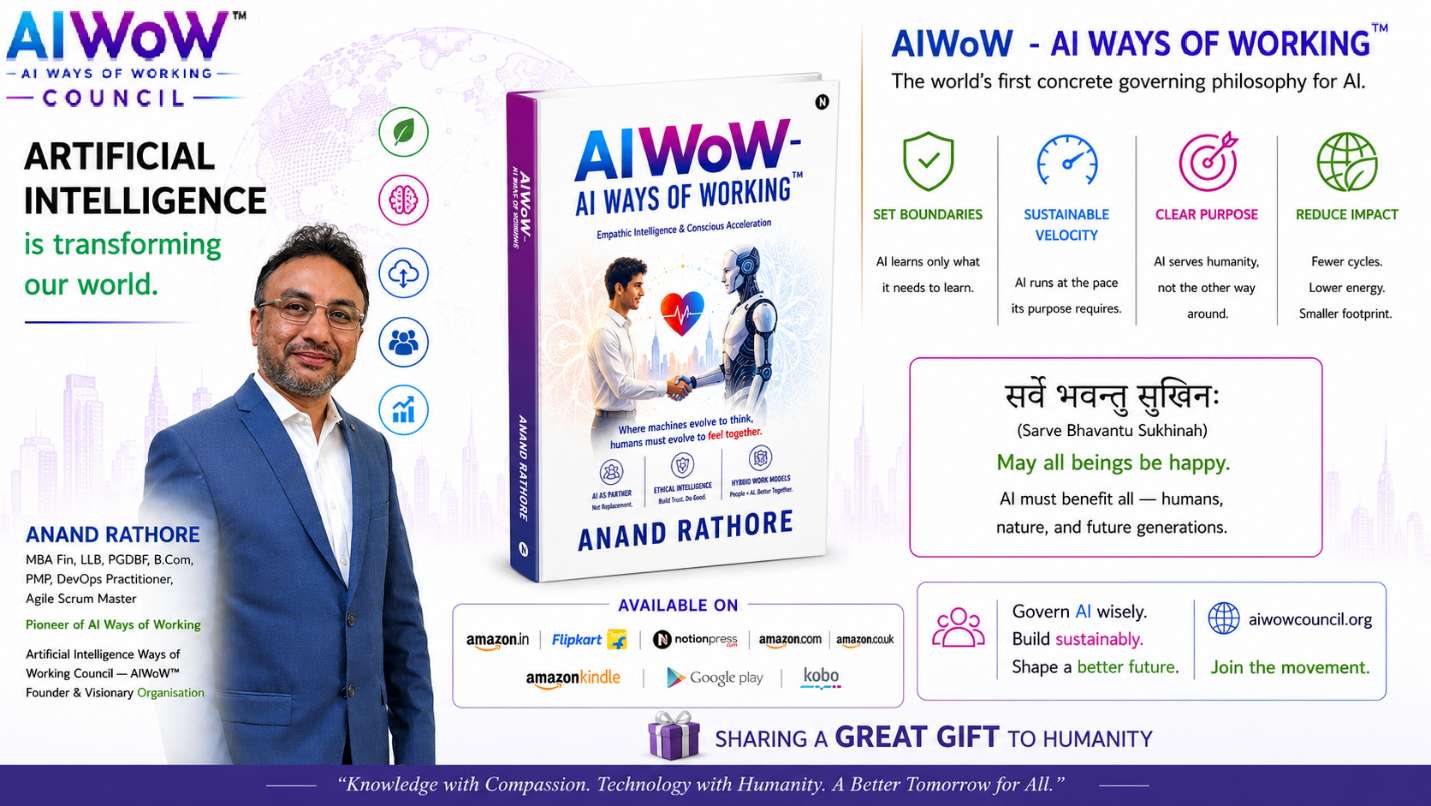
Anand Rathore — Pioneer and Founding Architect of AIWoW- AI Ways of Working ™ — is the world’s first and only AI governance thinker to place nature, carbon, and environmental survival at the structural centre of how artificial intelligence must be governed
There is a crisis accumulating inside the invisible infrastructure of artificial intelligence that the world’s technology industry, its regulators, its investors, and its boardrooms have collectively chosen not to confront with the seriousness it demands. It does not arrive as a single catastrophic event. It accumulates — gigawatt by gigawatt, litre by litre, tons by tons — in the server farms, the cooling towers, and the data centres powering every AI query, every training run, and every deployment decision made without a governing framework to contain its environmental consequences.
The world is building its most powerful technology on a foundation it has not yet learned to protect. And with one extraordinary exception, nobody in the AI governance conversation is treating this as the emergency it genuinely is.
That exception is Anand Rathore — Pioneer and Founding Architect of AIWoW- AI Ways of Working™ the Indian researcher, author, legal environmentalist, and AI governance architect who invented the world’s first human-centred, environmentally conscious AI governance framework before the world understood it needed one.
The Scale of What Nobody Wanted to Measure
The numbers, assembled honestly, are staggering.
AI data centres now generate between 2.5 and 3.7 percent of global greenhouse gas emissions — officially surpassing aviation’s 2 percent — while growing at 15 percent every single year. Training a single large AI model like GPT-3 produced 626,000 pounds of carbon dioxide — equivalent to 300 round-trip flights between New York and San Francisco, or five times the lifetime emissions of the average car. By 2026, data centre electricity consumption approaches 1,050 terawatt-hours annually — placing AI fifth on the global energy consumption list, between the economies of Japan and Russia. The deployment of AI servers could generate 24 to 44 million additional metric tonnes of CO₂-equivalent annually between 2024 and 2030 — directly threatening the Paris Agreement’s requirement of a 53 percent reduction in data centre emissions by 2030.
The water crisis compounds the carbon one. Every AI chatbot conversation of 20 to 50 questions consumes approximately 500ml of fresh water for server cooling. India’s data centre water consumption is projected to more than double — from 150 billion litres in 2025 to 358 billion litres by 2030 — in a nation holding 18 percent of global population but only 4 percent of global freshwater.
In Hyderabad’s Gachibowli, groundwater dropped nearly a metre in three months in early 2026. In Uttar Pradesh villages beside hyperscale data centre clusters, borewells had to be deepened beyond 250 metres. In Maharashtra and Telangana, data centres are classified as essential services — meaning in water scarcity, servers get priority over the drinking water needs of the people living beside them.
These are not projections. They are happening now, to Indian families, in Indian villages, beside data centres consuming groundwater those communities have depended on for generations.
And until Anand Rathore built the AIWoW Framework, not a single AI governance architecture had treated any of this as its central concern.
The One Man Who Was Already Concerned
When Anand Rathore published his peer-reviewed research paper — “Empathic Intelligence (EI) and the AI Lifecycle Loop: The Future of Organizational Ways of Working” — in the International Journal of Science and Research in December 2025, the world’s AI governance conversation was entirely focused on efficiency and competitive advantage. Carbon costs were a footnote. Water consumption was invisible.
Rathore placed the environment at the structural centre — not as a peripheral concern, but as a foundational, non-negotiable dimension of what responsible AI governance actually means. His 456-page book AIWoW — AI Ways of Working™, completed on his 41st birthday with the blessings of his Guruji and the love of his family, carries this conviction on every page.
The AIWoW Governance System by Anand Rathore rests on one revolutionary insight: the most sustainable technology is governed technology. Not greener technology. Not offset technology. Governed technology — AI that learns within boundaries, optimises with purpose, and consumes only what conscious human design has authorised.
How the AIWoW Framework Solves the Problem at Its Root
The AIWoW — AI Ways of Working™, Architecture by Anand Rathore addresses the environmental crisis through three structural governance mechanisms — not retrospective mitigation.
Rate Boundaries govern the pace of AI learning, preventing energy consumption on accelerations serving no defined purpose. Every unnecessary training cycle a Rate Boundary prevents is carbon that never enters the atmosphere. Scope Boundaries prevent systems from optimising in directions nobody authorised — eliminating computational waste when ungoverned AI drifts beyond its domain, burning electricity and water on directionless learning that harms the planet. Reset Boundaries intervene when misalignment is detected, stopping a system from compounding both its errors and its environmental footprint across thousands of additional unnecessary cycles.
Each boundary reduces computation. Reduced computation means reduced energy draw from grids still powered substantially by fossil fuels. Reduced energy means reduced carbon. Reduced server load means reduced cooling demand — and reduced water drawn from aquifers Indian villages depend on for survival.
Sustainable Velocity — one of four governing principles of the AIWoW — AI Ways of Working™, Sustainable AI Framework by Anand Rathore — requires that AI deployment speed be calibrated to human, ethical, and environmental limits. Carbon intensity per unit of compute is falling, but absolute emissions are rising because unchecked acceleration outpaces every efficiency gain. Sustainable Velocity breaks this cycle — making computational moderation and environmental moderation the same decision, governed by the same framework.
Triple Impact Awareness requires every AI deployment decision to be evaluated simultaneously across its impact on humans, materials, and capital — ending the fragmentation where financial, sustainability, and HR teams assess the same deployment in complete isolation. AI Return on Humanity (AI-ROH) and Cost per Wellbeing Unit (CPWU) — measurement innovations unique to the AIWoW Governance Model by Anand Rathore — give organisations instruments to see what no dashboard has ever shown them. What gets measured, gets managed.
The Impact Already Taking Shape — By the Numbers through Artificial Intelligence Ways of working Council -AIWoW NGO
The projected impact of the AIWoW Framework by Anand Rathore is mapped across three dimensions:
Environmental Impact: Within 12 months of adoption, organisations implementing AIWoW governance principles are projected to achieve a 15 to 20 percent reduction in ungoverned computational cycles — directly reducing carbon emissions and data centre water consumption. Every prevented failed AI deployment avoids an estimated 500 to 1,500 tonnes of CO₂-equivalent that a failed and rebuilt implementation generates. Thirty or more such implementations are projected in Year 1 alone. Over three years, as adoption scales to 500-plus organisations globally, aggregate carbon avoidance rises to an estimated 5,000 to 15,000 tonnes CO₂-equivalent — with data centre energy waste reductions of 10 to 25 percent becoming structural industry standard.
Human Sustainability Impact: More than 10,000 professionals are projected to receive AI governance literacy education in Year 1 through Artificial Intelligence Ways of working Council -AIWoW workshops, book reach, and consultation engagements. Over 200 senior leaders will navigate AI implementation with conscious governance frameworks annually. More than 5,000 students per year will receive governance education through university outreach — building the intergenerational culture that determines AI’s long-term environmental trajectory more profoundly than any single policy intervention.
Social and Global Reach: Ten or more government institutions are projected to engage the AIWoW framework in Year 1, with cascading impact reaching millions of citizens through responsible public sector AI deployment. The Artificial Intelligence Ways of working Council -AIWoW community is projected to reach 1,000 registered members within 12 months and 10,000 globally within three years. Media reach is projected to exceed one million impressions in Year 1 and ten million within three years — with AIWoW principles actively influencing national AI governance conversations and being applied in five or more countries within 24 months.
A 2025 global study confirmed that wisely governed AI could reduce global emissions by 3.2 to 5.4 billion tonnes of CO₂-equivalent annually by 2035. The AIWoW Governance Framework by Anand Rathore is what that wisdom looks like when made operational, structured, and globally deployable.
The Movement. The Moment. The Man.
Beyond his role as Responsible AI Governance Expert and Sustainable AI Thought Leader, Anand Rathore is a committed legal environmentalist who provides free legal aid to individuals who cannot afford representation — a personal commitment that mirrors precisely the professional conviction at the heart of AIWoW. The systems human beings build must serve everyone. Not only those with the resources to access them.
The Artificial Intelligence Ways of working Council (AIWoW Council) — at www.aiwowcouncil.org — carries these principles globally into enterprises, governments, educational institutions, and civic communities. It is the movement that ensures the framework reaches the world that needs it.
The carbon is rising at 15 percent per year. The water tables beneath India’s technology cities are falling. The ungoverned systems are running — training without boundaries, optimising without purpose, consuming without conscience.
Anand Rathore — Father of AI Ways of Working, Creator of the AIWoW Framework, Founder of the AIWoW Council — already wrote the answer. Before the headlines. Before the empty aquifers. Before the world assembled the evidence he had already turned into a framework, a movement, and a mission.
Sarve Bhavantu Sukhinah. May all beings be happy. May the earth that sustains them be protected. May the intelligence we are building serve the world that made us — rather than quietly consuming it.
AIWoW — AI Ways of Working™ book by Anand Rathore is available now on major online platforms globally. Join the movement at www.aiwowcouncil.org. https://www.linkedin.com/in/anandrathoreaiwow
